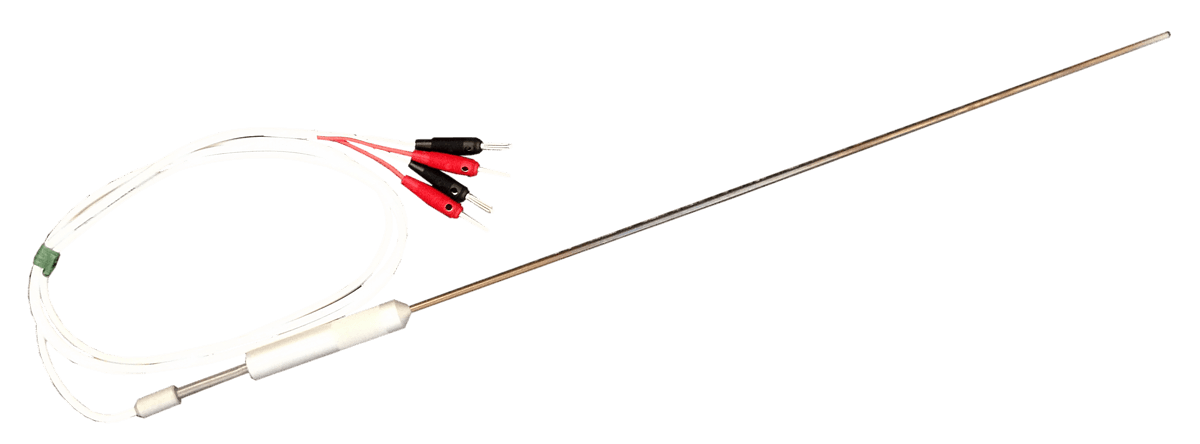
LR-Cal LRT F (Pt 100)
Precision reference resistance thermometer probe


- Precision temperature probe
Resistance thermometer Pt 100, class A - Measuring range -40...+450°C
- Diameter 4.5 or 6.0 mm
Description
LR-Cal LRT F (Pt 100) description
The LR-Cal LRT F RTD probes serve as optional external reference temperature sensors for the following LR-Cal temperature calibrators:
- LR-Cal LTC-FB-9018-60 with option LTC-MP-3I + LR-Cal LTC-FB-9035-45 with option LTC-MP-3I
- LR-Cal LTC-FB-0200-60 with option LTC-MP-3I + LR-Cal LTC-FB-0250-60 with option LTC-MP-3I
- LR-Cal BK 40-M-2I + LR-Cal BK 40-M-TR-2I
- LR-Cal TB 300-M-2I + LR-Cal TB 300-M-TR-2I
- LR-Cal LTC-DB-9050-35 with option LTC-MP-3I + LR-Cal LTC-DB-9030-35 with option LTC-MP-3I
- LR-Cal LTC-DB-0600-35 with option LTC-MP-3I + LR-Cal LTC-DB-0550-60-2I
They are supplied ready for connection with four matching banana plugs.
The LR-Cal LRT F (Pt 100) probe is connected to the second measurement input of the temperature calibrator - labeled “REF” - in the -2I version or the version with the LTC-MP-3I option. Its measured values are displayed on the temperature calibrator’s screen after the -2I version or the version with the LTC-MP-3I option has been configured accordingly.
The LR-Cal LRT F (Pt 100) precision RTD temperature probes are pre-aged to ensure particularly high long-term stability and optimum behavior even at high temperatures. They consist of particularly high-quality platinum elements, which ensure the highest possible accuracy and, more importantly, particularly high long-term stability and reproducibility.
Specification
LR-Cal LRT F (Pt 100) specification
| Measuring range | °C | -40...+450 |
| Dimension | mm | Code LRT-F-9040-0450-45: 480 x 4.5 diameter Code LRT-F-9040-0450-60: 480 x 6.0 diameter |
| Sensor | Pt100 (4 wires) class A, 100 Ohm, ±0.05 Ohm | |
| Alpha | 0,003850 ±0,00005 | |
| Standard | IEC 60751 | |
| Stability | Ohm/year | 0.010 |
| Lengh of sensitive part | mm | 15 |
| Cable length | m | 2 |
| Connection | Banana plugs suitable for option LTC-MP-3I for the LR-Cal dry block temperature calibrators and the LR-Cal fluid bath temperature calibrators |
Scope of standard supply
LR-Cal LRT F (Pt 100) scope of standard supply
- Resistance thermometer as described
Optional calibration certificates
LR-Cal LRT F (Pt 100) optional calibration certificates
- Code: WKZ-T-KAL-RT-6T
Factory calibration certificate, 6 test points, sensor only (without display)
- Code: WKZ-T-KAL-DT-3T
Factory calibration certificate, 3 test points, for measuring chain (Sensor and display of the LR-Cal LTC temperature calibrator with the LTC-MP-3I option or the -2I version)
- Code: WKZ-T-KAL-MP-3ZPP
Surcharge for 3 additional calibration points on the factory calibration certificate
- Code: DKD-T-KAL-RT-6T
DAkkS calibration certificate, 6 test points, sensor only (without display)
- Code: DKD-T-KAL-DT-3T
DAkkS calibration certificate, 3 test points, for measuring chain (Sensor and display of the LR-Cal LTC temperature calibrator with the LTC-MP-3I option or the -2I version)
- Code: DKD-T-KAL-MP-3ZPP
Surcharge for 3 additional calibration points for DAkkS calibration certificate
The heat treatment performed before shipment of each LR-Cal LRT F (Pt 100) reference sensor involves pre-aging the resistance temperature sensors.
A Pt 100 sensor’s resistance changes not only due to temperature but also due to changes in the microstructure of the platinum (Pt) material used. These effects cause drift:
- Lattice defects and mechanical stresses
During the sensor’s manufacture, vacancies and stresses develop in the platinum. When the sensor is first put into operation (exposed to temperature), these defects largely heal, causing the resistance to shift. - Impurities and oxidation
At higher temperatures, impurity atoms can diffuse into the platinum or react on the surface. These processes are most intense initially, during the first temperature cycles.
Through targeted annealing (near or even above the later maximum operating temperature) and thermal cycling, the processes described above are anticipated. The LR-Cal LRT F (Pt 100) reference sensor is then largely “stabilized” in its microstructure.
What are the benefits for you?
- Lower long-term drift
This is the main benefit. Pre-aged resistance temperature detectors, such as the LR-Cal LRT F (Pt 100), drift significantly less during operation than a newly manufactured one. - Better repeatability, lower hysteresis
The measured values deviate less from one another after such thermal cycles. - Calibration values remain valid longer
Class A describes the deviation from the reference value series when the sensor is new. Pre-aging does not improve accuracy; the accuracy used as a reference is established through calibration. This calibration is now based on a stable sensor, meaning you achieve greater stability and, consequently, an even more reliable calibration.