Calibration is the determination and documentation of deviations in a measuring device. This measuring device is compared with the measurement result of another measuring device (or standard), whereby the standard is traceable to national or international standards and therefore its correct and accurate function is known.
Adjustment
Adjustment involves intervening in the device to minimize a detected measurement deviation. Normally, a further calibration is carried out after an adjustment to verify that the intervention in the device was correct.
Traceability
Traceability involves comparing the measured value of a measuring device with a national or international standard. At each step, according to the hierarchy of standards, a measuring device is compared with a standard, which in turn has been calibrated with a higher-level standard. The calibration hierarchy ranges from company test equipment, working or factory standards, to reference standards and national standards.
Measurement uncertainty
Measurement uncertainty is a non-negative parameter and is specified without a sign. It characterizes the dispersion of the values associated with the measured quantity based on the information used.
Bath volume approx. 300 cm³ (45 mm diameter, 170 mm depth)
Option: changeable calibration bath insert
FLUID
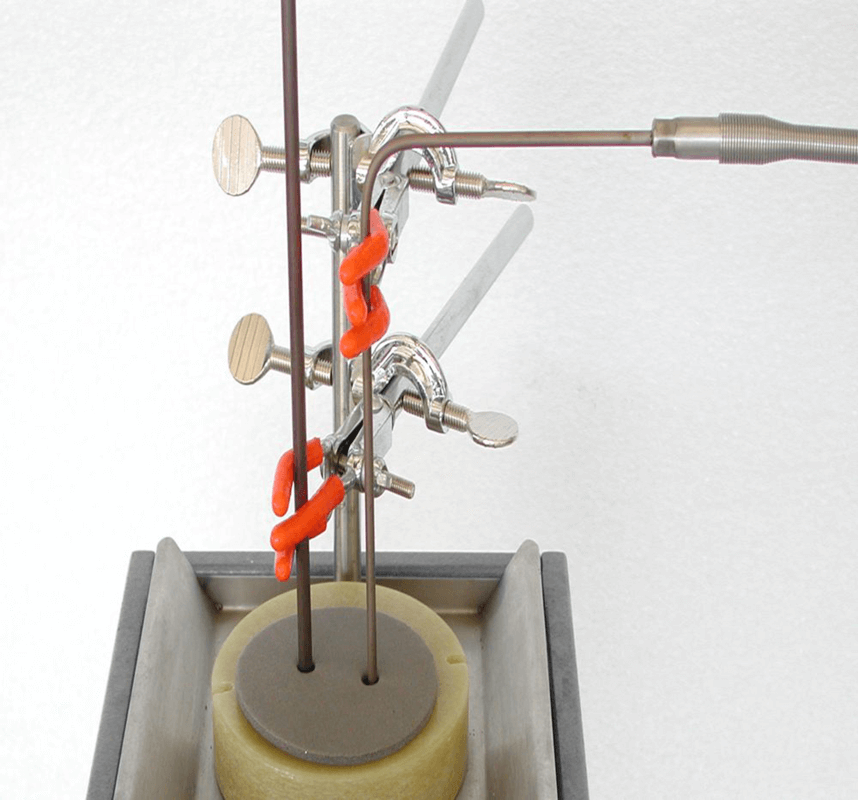
incl. support for test item and reference
FLUID
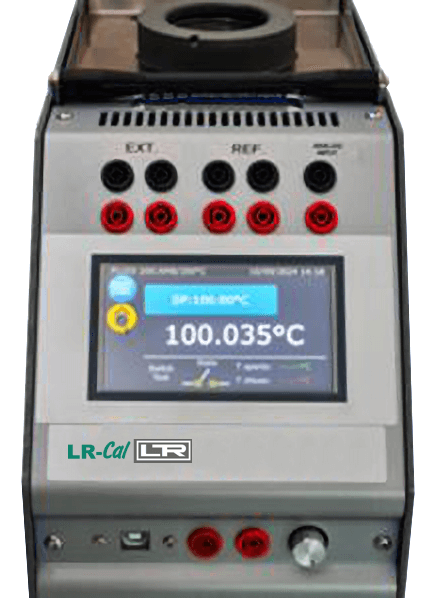
Simple operation via touchscreen
FLUID
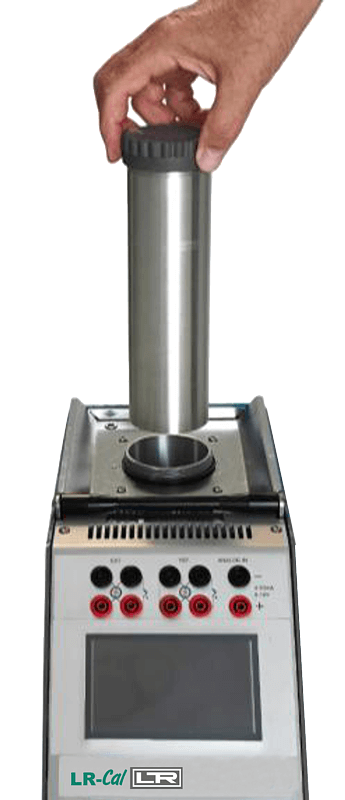
LTC-FB-INSERT Changeable calibration bath insert
FLUID
LTC-FB-ENT-TOOL
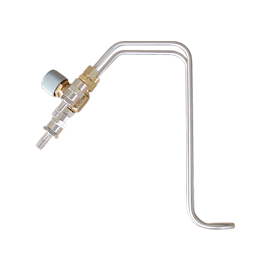
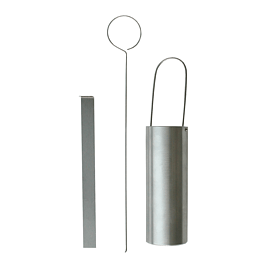
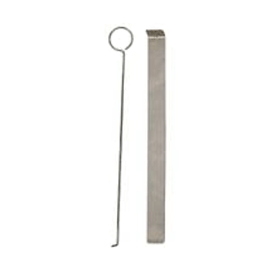
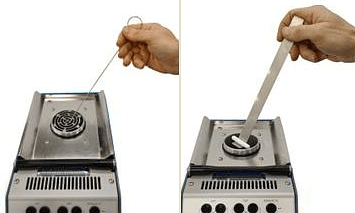
LTC-FB-ENT-TOOL Optional tool set for removing protective grilles + magnetic mixer rod (easier emptying+cleaning)
Description
LR-Cal LTC-FB-9035-45 Description
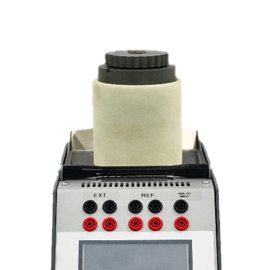
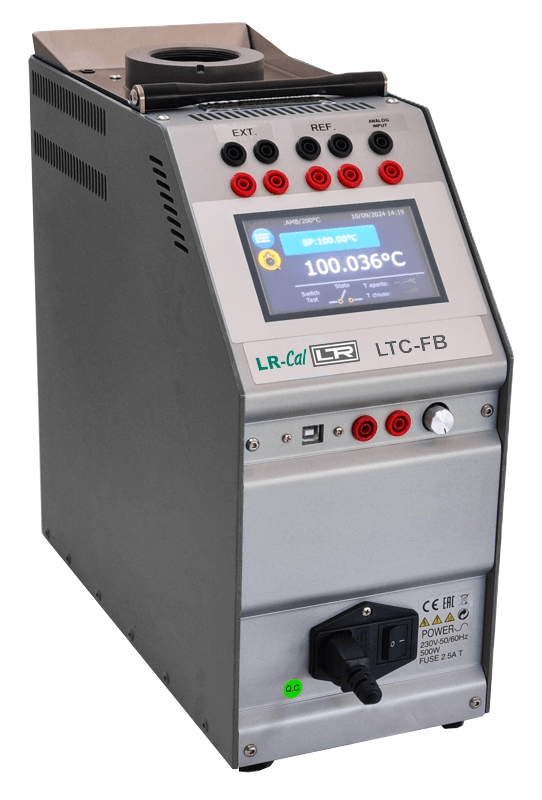
The LR-Cal LTC-FB-9035-45 portable temperature calibration bath serves as a temperature source and reference instrument in one, for testing and calibrating all types of temperature measuring instruments. Various metal block inserts are also available.
Optimal for calibration of glass thermometers and laboratory thermometers as well as temperature sensors with not exactly cylindrical shape
Homogeneous temperature distribution due to adjustable magnetic mixer
Simple operation with color touchscreen
Ramp function + thermostat tests
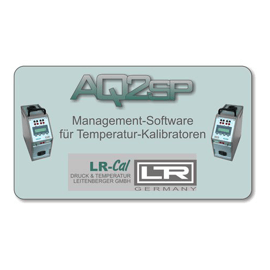
Computer-controlled calibrations via USB interface and optional software LR-Cal Aq2Sp2 for MS-Windows® computers
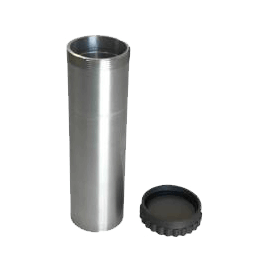
Option: changeable calibration bath insert for changing the calibration fluid without emptying and cleaning of the reservoir
Option: dry block inserts to convert the device to a dry block temperature calibrator
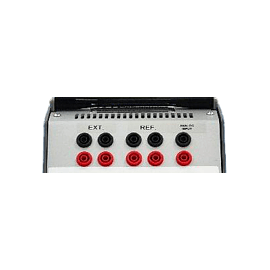
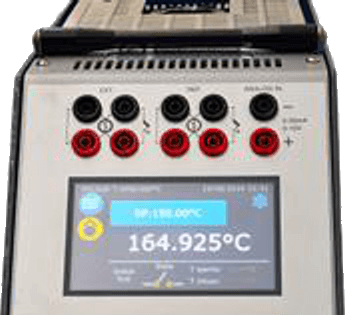
Option LTC-MP-3I - three configurable measuring inputs
The LTC-MP-3I option can be ordered together with the LR-Cal LTC-FB-9035-45:
Device version with 3 configurable measuring inputs. Of these, 2 for resistance thermometers (Pt 100 (2-, 3- or 4-wire) or Pt 100, or thermocouples incl. cold junction compensation, types B, E, J, K, N, R, S and T, and 1 measuring input for analog output signals 4...20 mA or 0...10 V. Order-Code: LTC-MP-3I (must be ordered together with the base unit) Extended scope of delivery: Electrical connection cables, plugs/terminals (red/black) for electrical connections
Accuracy (max. deviation) of resistance and thermocouple measurement inputs with option LTC-MP-3I:
Pt 100 or Pt 1000
at -40°C:
±0.09°C
at 0°C:
±0.08°C
at +150°C:
±0.11°C
at +300°C:
±0.14°C
Thermocouple type B
at +950°C:
±0.97°C
at +1050°C:
±1.03°C
at +1200°C:
±1.12°C
Thermocouple type E
at -40°C:
±0.42°C
at 0°C:
±0.40°C
at +350°C:
±0.61°C
Thermocouple type J
at +200°C:
±0.52°C
at +450°C:
±0.67°C
at +700°C:
±0.82°C
Thermocouple types K, N, R and S
at +400°C:
±0.64°C
at +700°C:
±0.82°C
at +1000°C:
±1.00°C
Thermocouple type T
at -40°C:
±0.42°C
at 0°C:
±0.40°C
at +350°C:
±0.61°C
Option LTC-MP-115V - device version for für 115 VAC
The LTC-MP-115V option can be ordered together with the LR-Cal LTC-FB-9035-45:
Device version for power supply 115 VAC 50/60 Hz (instead of für 230 VAC).
Specification
LR-Cal LTC-FB-9035-45 specification
Description:
Specification:
Temperature range:
-35...+120°C
Display + operation:
color touchscreen
Display accuracy:
±0.15°C *
Measuring units:
°C / °F / K
Displey resolution:
0.1° / 0.01° / 0.00^°
Mean heating time: (incl. stabilization)
approx. 40 min. from ambient temperature to +120°C
Mean cooling time: (incl. stabilization)
approx. 100 min. from +120°C to ambient temperature
Stability:
±0.02°C at 0°C **
Axial uniformity:
±0.05°C
Radial uniformity:
±0.02°C at 0°C ***
Hole diameter:
45 mm
Hole depth:
170 mm
Insert material:
anticorodal
Switch test; voltage:
Open/Closed; 4.5 VDC
Adjustable ramp function:
from 0.1°C/min
Computer interface:
USB type B
Automatic calibration:
at 5 temperature points
External sensors/probes:
Optional with Order-Code LTC-MP-3I (to be ordered together with instrument)
Operation voltage:
230 VAC (optional 115 VAC) 50/60 Hz
Electric powert:
350 VA
Dimensions:
160 x 360 x 350 mm
Weight incl. standard accessories:
11.0 kg
All values have been measured at ambient temperature of +20°C and with a sensor with diamter 6 mm. The achievement of stabilization is confirmec by a displayed root symbol and an audial beep. * = Temperature deviation between display and reference probe. ** = Max. temperature difference at stable temperature over 30 min. *** = Measured from the button up to 40 mm.
Scope of standard delivery
LR-Cal LTC-FB-9035-45 scope of delivery
Portable temperature calibration micro bath LR-Cal LTC-FB-9035-45
Spare fuses
Power supply cable
Connection cables for thermostat tests
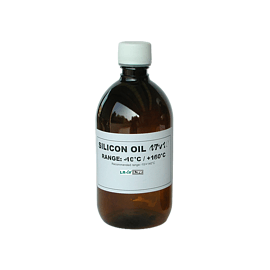
Bottle with 500 cm³ silicone oil 47V10
Holding support for test items, e.g. glass thermometers
Sealing cap for the reservoir (for transport purposes)
Carrying bag with shoulder trap
Only if option LTC-MP-3I is ordered with the device: electrical connection cables and plugs (red/black) for the three measuring inputs
Acceptance test certficate 3.1 in accordance with DIN EN 10204 (factory calibration certificate)
Operating manual DE+EN
Options + Accessories
LR-Cal LTC-FB-9035-45 options + accessories
3 configurablemeasuring inputs
Code: LTC-MP-3I
Option, must be ordered together with the calibrator: Device version with 3 configurable measuring inputs 2 x for Pt 100 / Pt 1000 / Thermocouples 1 x for analog signal 4-20mA / 0-10V
Power supply 115 VAC
Code: LTC-MP-115V
Option, must be ordered together with the calibrator: Device version for power supply 115 VAC 50/60 Hz (instead of 230 VAC) NO extra charge
Exchangeablecalibration bath insert
Code: LTC-FB-INSERT
Option: Calibration bath insert incl. closing cap For fast change of the silicone oil resp. the calibration fluid (without empying and cleaning the reservoir)
Cooling coil
Code: LTC-FB-COOL
Accessory: Stainless steel cooling coil. The cooling coil shortens the cooling time, and it can also shift the start of the working range of the calibrator downwards (but above 0°C). Requires fresh water connection
Windows-PCsoftware Aq2Sp2
Code: LTC-AQ2SP2
Accessory: Windows-PC software Aq2Sp2 (delivered as download link)
Accessory: Dry block conversion kit (aluminum) Diameter 44.7 mm Depth 170 mm Without holes (for self-drilling)
Conversion kit to dry block calibrator
Code: LTC-FB-DB-45-7
Accessory: Dry block conversion kit (aluminum) Diameter 44.7 mm Depth 170 mm With 7 drillings/holes: 4.0+4.5+5.5+6.5+8.5+10.5 mm
Conversion kit to dry block calibrator
Code: LTC-FB-DB-45-9
Accessory: Dry block conversion kit (aluminum) Diameter 44.7 mm Depth 170 mm With 9 drillings/holes: 3.5+4.5+4.5 +5.5+6.5+6.5+6.5+8.5+10.5 mm
Sturdy caseAluminum
Code: LTC-FB-DB-KOFFER
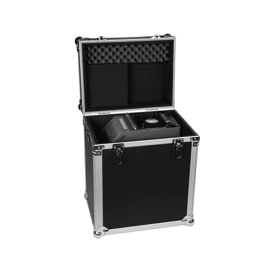
Accessory: Sturdy case made of aluminum with molded foam inserts Dimension 450 x 280 x 380 mm Weight 4.8 kg Shipping dimensions: 600 x 370 x 500 mm
Carrying bag with shoulder trap
Code: LTC-FB-DB-TASCHE
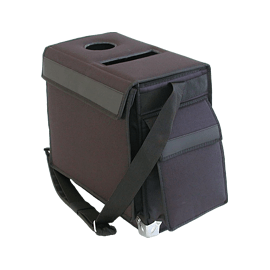
Spare part: Carrying bag with shoulder trap Dimension 410 x 220 x 380 mm Weight 1.45 kg Shipping dimensions: 600 x 370 x 500 mm (1 bag ist included in calibrators delivery)
Removal tools for protect. grill + mixer rod
Code: LTC-FB-ENT-TOOL
Accessory: Removal tools for protective grilles and magnetic mixer rod Facilitates emptying and cleaning (Already included in the scope of delivery of LTC-FB-INSERT and LTC-FB-DB-... inserts)
DAkkS-certification
Code: DKD-T-KAL-TK-6T
Option: DAkkS certificate of calibration
For the measuring chain consisting of display of the calibrator and reference sensor, 6 measuring points
Silikone oil 47V5 (200C5)
Art.Nr.: LTC-FB-SO-005
Accessory: 500 cm³ calibration fluid Silicone oil 47V5 (200C5) for temperature -40...+130°C
Silikone oil 47V10
Code: LTC-FB-SO-010
Spare part: 500 cm³ calibration fluid Silikone oil 47V10 for temperature -30...+150°C (1 bottle included in calibrators scope of delivery)
Suitable reference sensors (probes) for calibrator version with option LTC-MP-3I (3 configurable measuring inputs):
External reference thermocouple see LR-Cal LRT-F (TC)...
What is temperature calibration with a temperature calibration bath?
What is temperature calibration with a temperature calibration bath?
The test item (temperature measuring instruments of all types, e.g. dial thermometers, glass thermometers, resistance thermometers, temperature switches, thermostats, etc.) and the reference temperature measuring instrument (installed in the calibrator or external reference) are both subjected to test temperatures. The measured values of the reference are compared with the values of the test item. In this way, a statement can be made not only about the function of the test item, but also about the measurement accuracy or the measured value deviation of the test item.
Please note that the specifications regarding radial and axial temperature uniformity given in the respective technical data refer to specific immersion depths and do not necessarily apply to all immersion depths in every case. The temperature range specifications apply at an ambient temperature of +20°C.
The LR-Cal temperature calibration baths have an internal (built-in) reference. If its accuracy is not sufficient, an external reference (without or with its own display) can be used.
The LTC-MP-3I option is available for the portable LR-Cal LTC temperature calibration baths (with the exception of the LR-Cal LTC 150/250-F(-PLUS) devices), with three measuring inputs (2 x for RTD/TC and 1 x for analog signal 4...20 mA/0...10 V).
The stationary LR-Cal temperature calibration baths are available in two versions: standard version and “-2I” version with 2 measuring inputs (for RTD/TC).
Furthermore, the LR-Cal Aq2Sp2 PC software is available as an option for the LR-Cal temperature calibration baths. With this, the calibrator can be completely controlled from the PC via its serial interface, manual or automatic calibration of one or more DUTs, load and lifetime tests, thermostat tests, as well as the creation of calibration certificates.
Synonyms
Temperature calibration baths are also referred to as
Calibration bath
Micro bath
Temperature bath
Temperature calibrator
Temperature calibration device
Temperature calibration bath
Information about operating fluids for temperature calibration baths
Calibration liquids for LR-Cal temperature calibration baths
Applications:
Thermostatic fluids for micro baths and thermostatic temperature calibration baths
Main Characteristics:
Operating range -50...+200°C
High stability
Good thermal conductivity
Nearly odourless
Long service live
Packaged in bottle or canister
Different types for a wide range applications
Low toxicity
Low viscosity and corrosovity
Our thermostatic fluids are suitable for use in liquid thermostatic calibrators and thermostatic baths for applications from -50°C to +200°C. The choice of thermostatic fluid is the most important aspect for obtaining the best results with regard to operation and temperature control of calibrators and baths. These fluids have perfect thermodynamic characteristics to guarantee the best performance in the various fields of application, ensuring safe and reliable operation as well as optimum heat transfer efficiency. Silicone-based fluids are chemically inert substances that do not affect metals, are resistant to weathering and, when used correctly, the very low formation of cracking and oxidation ensures a long service life.
Most of our thermostatic fluids are available in different containers: 500 cm³ bottles or 9 kg canisters (25 kg on request).
Temperature application ranges of the various operating fluids:
Type of calibration medium (liquid)
Usable range (1)
Temperature above which fume hood should be provided (2)
Fume burning (3)
A viscosity of 10 cst exists at a temperature of (4)
Freezing temperature (5)
Glycol 56% + water *
-40...+90°C
+70°C
>110°C
+20°C
-43°C
Silicone oil 47V5
-40...+130°C
+110°C
+136°C
+5°C
-65°C
Silicone oil 47V10
-30...+150°C
+120°C
+160°C
+20°C
-65°C
Silicone oil 47V20
-20...+200°C **
+130°C
+230°C
+60°C
-60°C
Silicone oil 47V50
+30...+250°C **
+140°C
+280°C
+160°C
-55°C
Silicone oil 47V100
+50...+200°C **
+170°C
>300°C
+200°C
-55°C
Silicone oil 47V150
+50...+200°C **
+190°C
>300°C
-/-
-55°C
Note:
Note text:
*
Mixture of 56% Glycol + 44% water
**
In order to avoid gelling, it is recommended not to exceed a temperature of 200°C for a long time; even for fluids with wider operating ranges
(1)
Usable range The “usable range” of a calibration liquid is the temperature range in which it can be used under optimum conditions. The range may be limited by viscosity, flash points, freezing points, boiling points, evaporation rates, tendency to gel (or polymerize), etc. There is no liquid that covers extremely wide temperature ranges. Therefore, you should ideally use a separate calibration liquid for each temperature range. The recommended range is the one in which the viscosity is not optimal, but still reaches values that allow proper use.
(2)
Use of a fume hood The use of an exhaust hood when using temperature calibration baths prevents users from inhaling vapors from calibration liquids. It is best to use extraction devices near the access opening to the calibration bath. Vapors can otherwise settle on the mucous membranes of the eyes or on the skin, causing discomfort. Silicone oils can form benzene and formaldehyde when they decompose at high temperatures. The table shows the temperature above which an extractor hood should be used.
(3)
Flash point The table shows the temperature value at which the presence of an open flame can ignite vapours combustion.
(4)
Viscosity Viscosity is a measure of the flow resistance of a liquid. Viscosity increases with decreasing temperature. Kinetic viscosity is the ratio of absolute viscosity to density. This is measured in stokes and centistokes (cSt). 1 cSt = 1 stoke divided by 100. The higher the cSt, the more viscous or dense the liquid. Excessively viscous liquids place a strain on the stirring and pumping mechanisms of the calibration bath and do not transfer heat sufficiently. The table shows the temperature value below which the performance of the temperature calibration bath is no longer optimal. The equivalent value of water at 20°C is 1.1 cst.
(5)
Freezing point Silicone oils also change their state below a certain temperature by solidifying. The table shows the value at which the calibration fluid changes its state and solidifies.
Other physical and chemical properties
Specific heat The specific heat is the amount of heat required to raise or lower the temperature by 1 °C per kg. The specific heat, called CP, is expressed in Kcal/Kg °C. The energy required to heat or cool the calibration liquids depends on the amount of liquid contained in the calibrator in kg and its specific heat. A high specific heat value requires more energy to change the temperature, but offers greater temperature stability. The average CP of silicone fluids is 35 Kcal/Kg °C. The CP of water at 20 °C is equal to 1.
Thermal conductivity Thermal conductivity is the ability of the liquid to transfer heat from one molecule to another. The better the heat transfer, the faster the liquid heats or cools. Better thermal conductivity improves the temperature uniformity in the reservoir of the calibration bath.
Expansion All liquids have a coefficient of thermal expansion. This indicates how much the volume of a liquid changes (expands or contracts) when the temperature changes. Liquid expansion has an important impact on the safety, cleanliness and maintenance of temperature calibration baths. If calibrators are filled with too much liquid at a low temperature and then heated without regard to the increase in volume, they can overflow.
If too little liquid is filled in the reservoir, below the level of the heating elements, the temperature rise of the non-immersed part of the heating elements could ignite the liquid.
Gelation (polymerization) The gelling temperature is the temperature at which silicone fluids oxidize, gel and turn into a viscous slurry. The main cause of this phenomenon is oxidation. Although silicone fluids can be used safely up to their flash point, the susceptibility to polymerization increases when used above their oxidation point. To prevent polymerization, it is advisable to keep the operating time above the oxidation point of the silicone oil used as short as possible in order to keep contaminants (salts, other oils and oxidizing agents) away. The calibration fluid must be replaced if it becomes dark, viscous or temperature unstable. It is important to limit the application time at high temperatures to prevent the oil from degrading and to extend its service life.
Bath volume approx. 500 cm³ (60 mm diameter, 170 mm depth)
Option: changeable calibration bath insert
FLUID
incl. support for test item and reference
FLUID
Simple operation via touchscreen
FLUID
LTC-FB-INSERT Changeable calibration bath insert
LTC-FB-ENT-TOOL
LTC-FB-ENT-TOOL Optional tool set for removing protective grilles + magnetic mixer rod (easier emptying+cleaning)
Description
LR-Cal LTC-FB-9018-60 Description
The LR-Cal LTC-FB-9018-60 portable temperature calibration bath serves as a temperature source and reference instrument in one, for testing and calibrating all types of temperature measuring instruments. Various metal block inserts are also available.
Optimal for calibration of glass thermometers and laboratory thermometers as well as temperature sensors with not exactly cylindrical shape
Homogeneous temperature distribution due to adjustable magnetic mixer
Simple operation with color touchscreen
Ramp function + thermostat tests
Computer-controlled calibrations via USB interface and optional software LR-Cal Aq2Sp2 for MS-Windows® computers
Option: changeable calibration bath insert for changing the calibration fluid without emptying and cleaning of the reservoir
Option: dry block inserts to convert the device to a dry block temperature calibrator
Option LTC-MP-3I - three configurable measuring inputs
The LTC-MP-3I option can be ordered together with the LR-Cal LTC-FB-9018-60:
Device version with 3 configurable measuring inputs. Of these, 2 for resistance thermometers (Pt 100 (2-, 3- or 4-wire) or Pt 100, or thermocouples incl. cold junction compensation, types B, E, J, K, N, R, S and T, and 1 measuring input for analog output signals 4...20 mA or 0...10 V. Order-Code: LTC-MP-3I (must be ordered together with the base unit) Extended scope of delivery: Electrical connection cables, plugs/terminals (red/black) for electrical connections
Accuracy (max. deviation) of resistance and thermocouple measurement inputs with option LTC-MP-3I:
Pt 100 or Pt 1000
at -40°C:
±0.09°C
at 0°C:
±0.08°C
at +150°C:
±0.11°C
at +300°C:
±0.14°C
Thermocouple type B
at +950°C:
±0.97°C
at +1050°C:
±1.03°C
at +1200°C:
±1.12°C
Thermocouple type E
at -40°C:
±0.42°C
at 0°C:
±0.40°C
at +350°C:
±0.61°C
Thermocouple type J
at +200°C:
±0.52°C
at +450°C:
±0.67°C
at +700°C:
±0.82°C
Thermocouple types K, N, R and S
at +400°C:
±0.64°C
at +700°C:
±0.82°C
at +1000°C:
±1.00°C
Thermocouple type T
at -40°C:
±0.42°C
at 0°C:
±0.40°C
at +350°C:
±0.61°C
Option LTC-MP-115V - device version for für 115 VAC
The LTC-MP-115V option can be ordered together with the LR-Cal LTC-FB-9018-60:
Device version for power supply 115 VAC 50/60 Hz (instead of für 230 VAC).
Specification
LR-Cal LTC-FB-9018-60 specification
Description:
Specification:
Temperature range:
-18...+140°C
Display + operation:
color touchscreen
Display accuracy:
±0.15°C *
Measuring units:
°C / °F / K
Displey resolution:
0.1° / 0.01° / 0.00^°
Mean heating time: (incl. stabilization)
approx. 50 min. from ambient temperature to +140°C
Mean cooling time: (incl. stabilization)
approx. 50 min. from +140°C to ambient temperature
Stability:
±0.02°C at 0°C **
Axial uniformity:
±0.05°C
Radial uniformity:
±0.07°C at +140°C ***
Hole diameter:
60 mm
Hole depth:
170 mm
Insert material:
anticorodal
Switch test; voltage:
Open/Closed; 4.5 VDC
Adjustable ramp function:
from 0.1°C/min
Computer interface:
USB type B
Automatic calibration:
at 5 temperature points
External sensors/probes:
Optional with Order-Code LTC-MP-3I (to be ordered together with instrument)
Operation voltage:
230 VAC (optional 115 VAC) 50/60 Hz
Electric powert:
300 VA
Dimensions:
160 x 360 x 350 mm
Weight incl. standard accessories:
11.0 kg
All values have been measured at ambient temperature of +20°C and with a sensor with diamter 6 mm. The achievement of stabilization is confirmec by a displayed root symbol and an audial beep. * = Temperature deviation between display and reference probe. ** = Max. temperature difference at stable temperature over 30 min. *** = Measured from the button up to 40 mm.
Scope of standard delivery
LR-Cal LTC-FB-9018-60 scope of delivery
Portable temperature calibration micro bath LR-Cal LTC-FB-9018-60
Spare fuses
Power supply cable
Connection cables for thermostat tests
Bottle with 500 cm³ silicone oil 47V10
Holding support for test items, e.g. glass thermometers
Sealing cap for the reservoir (for transport purposes)
Carrying bag with shoulder trap
Only if option LTC-MP-3I is ordered with the device: electrical connection cables and plugs (red/black) for the three measuring inputs
Acceptance test certficate 3.1 in accordance with DIN EN 10204 (factory calibration certificate)
Operating manual DE+EN
Options + Accessories
LR-Cal LTC-FB-9018-60 options + accessories
3 configurablemeasuring inputs
Code: LTC-MP-3I
Option, must be ordered together with the calibrator: Device version with 3 configurable measuring inputs 2 x for Pt 100 / Pt 1000 / Thermocouples 1 x for analog signal 4-20mA / 0-10V
Power supply 115 VAC
Code: LTC-MP-115V
Option, must be ordered together with the calibrator: Device version for power supply 115 VAC 50/60 Hz (instead of 230 VAC) NO extra charge
Exchangeablecalibration bath insert
Code: LTC-FB-INSERT
Option: Calibration bath insert incl. closing cap For fast change of the silicone oil resp. the calibration fluid (without empying and cleaning the reservoir)
Extension of the immersion depth
Code: LTC-FB-LONG
Accessory: Extension tube to increase the immersion depth Total length 255 mm Usable immersion depth 230 mm
Cooling coil
Code: LTC-FB-COOL
Accessory: Stainless steel cooling coil. The cooling coil shortens the cooling time, and it can also shift the start of the working range of the calibrator downwards (but above 0°C). Requires fresh water connection
Windows-PCsoftware Aq2Sp2
Code: LTC-AQ2SP2
Accessory: Windows-PC software Aq2Sp2 (delivered as download link)
Accessory: Dry block conversion kit (aluminum) Diameter 60 mm Depth 170 mm Without holes (for self-drilling)
Conversion kit to dry block calibrator
Code: LTC-FB-DB-60-9
Accessory: Dry block conversion kit (aluminum) Diameter 60 mm Depth 170 mm With 9 drillings/holes: 4.0+4.0+4.5 +5.5+6.5+6.5+8.5+10.5+12.5 mm
Sturdy caseAluminum
Code: LTC-FB-DB-KOFFER
Accessory: Sturdy case made of aluminum with molded foam inserts Dimension 450 x 280 x 380 mm Weight 4.8 kg Shipping dimensions: 600 x 370 x 500 mm
Carrying bag with shoulder trap
Code: LTC-FB-DB-TASCHE
Spare part: Carrying bag with shoulder trap Dimension 410 x 220 x 380 mm Weight 1.45 kg Shipping dimensions: 600 x 370 x 500 mm (1 bag ist included in calibrators delivery)
Removal tools for protect. grill + mixer rod
Code: LTC-FB-ENT-TOOL
Accessory: Removal tools for protective grilles and magnetic mixer rod Facilitates emptying and cleaning (Already included in the scope of delivery of LTC-FB-INSERT and LTC-FB-DB-... inserts)
DAkkS-certification
Code: DKD-T-KAL-TK-6T
Option: DAkkS certificate of calibration
For the measuring chain consisting of display of the calibrator and reference sensor, 6 measuring points
Silikone oil 47V10
Code: LTC-FB-SO-010
Spare part: 500 cm³ calibration fluid Silikone oil 47V10 for temperature -30...+150°C (1 bottle included in calibrators scope of delivery)
Silikone oil 47V20
Code: LTC-FB-SO-020
Accessory: 500 cm³ calibration fluid Silikone oil 47V20 for temperature -20...+200°C
Suitable reference sensors (probes) for calibrator version with option LTC-MP-3I (3 configurable measuring inputs):
External reference thermocouple see LR-Cal LRT-F (TC)...
What is temperature calibration with a temperature calibration bath?
What is temperature calibration with a temperature calibration bath?
The test item (temperature measuring instruments of all types, e.g. dial thermometers, glass thermometers, resistance thermometers, temperature switches, thermostats, etc.) and the reference temperature measuring instrument (installed in the calibrator or external reference) are both subjected to test temperatures. The measured values of the reference are compared with the values of the test item. In this way, a statement can be made not only about the function of the test item, but also about the measurement accuracy or the measured value deviation of the test item.
Please note that the specifications regarding radial and axial temperature uniformity given in the respective technical data refer to specific immersion depths and do not necessarily apply to all immersion depths in every case. The temperature range specifications apply at an ambient temperature of +20°C.
The LR-Cal temperature calibration baths have an internal (built-in) reference. If its accuracy is not sufficient, an external reference (without or with its own display) can be used.
The LTC-MP-3I option is available for the portable LR-Cal LTC temperature calibration baths (with the exception of the LR-Cal LTC 150/250-F(-PLUS) devices), with three measuring inputs (2 x for RTD/TC and 1 x for analog signal 4...20 mA/0...10 V).
The stationary LR-Cal temperature calibration baths are available in two versions: standard version and “-2I” version with 2 measuring inputs (for RTD/TC).
Furthermore, the LR-Cal Aq2Sp2 PC software is available as an option for the LR-Cal temperature calibration baths. With this, the calibrator can be completely controlled from the PC via its serial interface, manual or automatic calibration of one or more DUTs, load and lifetime tests, thermostat tests, as well as the creation of calibration certificates.
Synonyms
Temperature calibration baths are also referred to as
Calibration bath
Micro bath
Temperature bath
Temperature calibrator
Temperature calibration device
Temperature calibration bath
Information about operating fluids for temperature calibration baths
Calibration liquids for LR-Cal temperature calibration baths
Applications:
Thermostatic fluids for micro baths and thermostatic temperature calibration baths
Main Characteristics:
Operating range -50...+200°C
High stability
Good thermal conductivity
Nearly odourless
Long service live
Packaged in bottle or canister
Different types for a wide range applications
Low toxicity
Low viscosity and corrosovity
Our thermostatic fluids are suitable for use in liquid thermostatic calibrators and thermostatic baths for applications from -50°C to +200°C. The choice of thermostatic fluid is the most important aspect for obtaining the best results with regard to operation and temperature control of calibrators and baths. These fluids have perfect thermodynamic characteristics to guarantee the best performance in the various fields of application, ensuring safe and reliable operation as well as optimum heat transfer efficiency. Silicone-based fluids are chemically inert substances that do not affect metals, are resistant to weathering and, when used correctly, the very low formation of cracking and oxidation ensures a long service life.
Most of our thermostatic fluids are available in different containers: 500 cm³ bottles or 9 kg canisters (25 kg on request).
Temperature application ranges of the various operating fluids:
Type of calibration medium (liquid)
Usable range (1)
Temperature above which fume hood should be provided (2)
Fume burning (3)
A viscosity of 10 cst exists at a temperature of (4)
Freezing temperature (5)
Glycol 56% + water *
-40...+90°C
+70°C
>110°C
+20°C
-43°C
Silicone oil 47V5
-40...+130°C
+110°C
+136°C
+5°C
-65°C
Silicone oil 47V10
-30...+150°C
+120°C
+160°C
+20°C
-65°C
Silicone oil 47V20
-20...+200°C **
+130°C
+230°C
+60°C
-60°C
Silicone oil 47V50
+30...+250°C **
+140°C
+280°C
+160°C
-55°C
Silicone oil 47V100
+50...+200°C **
+170°C
>300°C
+200°C
-55°C
Silicone oil 47V150
+50...+200°C **
+190°C
>300°C
-/-
-55°C
Note:
Note text:
*
Mixture of 56% Glycol + 44% water
**
In order to avoid gelling, it is recommended not to exceed a temperature of 200°C for a long time; even for fluids with wider operating ranges
(1)
Usable range The “usable range” of a calibration liquid is the temperature range in which it can be used under optimum conditions. The range may be limited by viscosity, flash points, freezing points, boiling points, evaporation rates, tendency to gel (or polymerize), etc. There is no liquid that covers extremely wide temperature ranges. Therefore, you should ideally use a separate calibration liquid for each temperature range. The recommended range is the one in which the viscosity is not optimal, but still reaches values that allow proper use.
(2)
Use of a fume hood The use of an exhaust hood when using temperature calibration baths prevents users from inhaling vapors from calibration liquids. It is best to use extraction devices near the access opening to the calibration bath. Vapors can otherwise settle on the mucous membranes of the eyes or on the skin, causing discomfort. Silicone oils can form benzene and formaldehyde when they decompose at high temperatures. The table shows the temperature above which an extractor hood should be used.
(3)
Flash point The table shows the temperature value at which the presence of an open flame can ignite vapours combustion.
(4)
Viscosity Viscosity is a measure of the flow resistance of a liquid. Viscosity increases with decreasing temperature. Kinetic viscosity is the ratio of absolute viscosity to density. This is measured in stokes and centistokes (cSt). 1 cSt = 1 stoke divided by 100. The higher the cSt, the more viscous or dense the liquid. Excessively viscous liquids place a strain on the stirring and pumping mechanisms of the calibration bath and do not transfer heat sufficiently. The table shows the temperature value below which the performance of the temperature calibration bath is no longer optimal. The equivalent value of water at 20°C is 1.1 cst.
(5)
Freezing point Silicone oils also change their state below a certain temperature by solidifying. The table shows the value at which the calibration fluid changes its state and solidifies.
Other physical and chemical properties
Specific heat The specific heat is the amount of heat required to raise or lower the temperature by 1 °C per kg. The specific heat, called CP, is expressed in Kcal/Kg °C. The energy required to heat or cool the calibration liquids depends on the amount of liquid contained in the calibrator in kg and its specific heat. A high specific heat value requires more energy to change the temperature, but offers greater temperature stability. The average CP of silicone fluids is 35 Kcal/Kg °C. The CP of water at 20 °C is equal to 1.
Thermal conductivity Thermal conductivity is the ability of the liquid to transfer heat from one molecule to another. The better the heat transfer, the faster the liquid heats or cools. Better thermal conductivity improves the temperature uniformity in the reservoir of the calibration bath.
Expansion All liquids have a coefficient of thermal expansion. This indicates how much the volume of a liquid changes (expands or contracts) when the temperature changes. Liquid expansion has an important impact on the safety, cleanliness and maintenance of temperature calibration baths. If calibrators are filled with too much liquid at a low temperature and then heated without regard to the increase in volume, they can overflow.
If too little liquid is filled in the reservoir, below the level of the heating elements, the temperature rise of the non-immersed part of the heating elements could ignite the liquid.
Gelation (polymerization) The gelling temperature is the temperature at which silicone fluids oxidize, gel and turn into a viscous slurry. The main cause of this phenomenon is oxidation. Although silicone fluids can be used safely up to their flash point, the susceptibility to polymerization increases when used above their oxidation point. To prevent polymerization, it is advisable to keep the operating time above the oxidation point of the silicone oil used as short as possible in order to keep contaminants (salts, other oils and oxidizing agents) away. The calibration fluid must be replaced if it becomes dark, viscous or temperature unstable. It is important to limit the application time at high temperatures to prevent the oil from degrading and to extend its service life.
Bath volume approx. 500 cm³ (60 mm diameter, 170 mm depth)
Option: changeable calibration bath insert
FLUID
incl. support for test item and reference
FLUID
Simple operation via touchscreen
FLUID
LTC-FB-INSERT Changeable calibration bath insert
LTC-FB-ENT-TOOL
LTC-FB-ENT-TOOL Optional tool set for removing protective grilles + magnetic mixer rod (easier emptying+cleaning)
Description
LR-Cal LTC-FB-0200-60 Description
The LR-Cal LTC-FB-0200-60 portable temperature calibration bath serves as a temperature source and reference instrument in one, for testing and calibrating all types of temperature measuring instruments. Various metal block inserts are also available.
Optimal for calibration of glass thermometers and laboratory thermometers as well as temperature sensors with not exactly cylindrical shape
Homogeneous temperature distribution due to adjustable magnetic mixer
Simple operation with color touchscreen
Ramp function + thermostat tests
Computer-controlled calibrations via USB interface and optional software LR-Cal Aq2Sp2 for MS-Windows® computers
Option: changeable calibration bath insert for changing the calibration fluid without emptying and cleaning of the reservoir
Option: dry block inserts to convert the device to a dry block temperature calibrator
Option LTC-MP-3I - three configurable measuring inputs
The LTC-MP-3I option can be ordered together with the LR-Cal LTC-FB-0200-60:
Device version with 3 configurable measuring inputs. Of these, 2 for resistance thermometers (Pt 100 (2-, 3- or 4-wire) or Pt 100, or thermocouples incl. cold junction compensation, types B, E, J, K, N, R, S and T, and 1 measuring input for analog output signals 4...20 mA or 0...10 V. Order-Code: LTC-MP-3I (must be ordered together with the base unit) Extended scope of delivery: Electrical connection cables, plugs/terminals (red/black) for electrical connections
Accuracy (max. deviation) of resistance and thermocouple measurement inputs with option LTC-MP-3I:
Pt 100 or Pt 1000
at -40°C:
±0.09°C
at 0°C:
±0.08°C
at +150°C:
±0.11°C
at +300°C:
±0.14°C
Thermocouple type B
at +950°C:
±0.97°C
at +1050°C:
±1.03°C
at +1200°C:
±1.12°C
Thermocouple type E
at -40°C:
±0.42°C
at 0°C:
±0.40°C
at +350°C:
±0.61°C
Thermocouple type J
at +200°C:
±0.52°C
at +450°C:
±0.67°C
at +700°C:
±0.82°C
Thermocouple types K, N, R and S
at +400°C:
±0.64°C
at +700°C:
±0.82°C
at +1000°C:
±1.00°C
Thermocouple type T
at -40°C:
±0.42°C
at 0°C:
±0.40°C
at +350°C:
±0.61°C
Option LTC-MP-115V - device version for für 115 VAC
The LTC-MP-115V option can be ordered together with the LR-Cal LTC-FB-0200-60:
Device version for power supply 115 VAC 50/60 Hz (instead of für 230 VAC).
Specification
LR-Cal LTC-FB-0200-60 specification
Description:
Specification:
Temperature range:
ambient temperature...+200°C
Display + operation:
color touchscreen
Display accuracy:
±0.2°C *
Measuring units:
°C / °F / K
Displey resolution:
0.1° / 0.01° / 0.00^°
Mean heating time: (incl. stabilization)
approx. 30 min. from ambient temperature to +200°C
Mean cooling time: (incl. stabilization)
approx. 75 min. from +200°C to ambient temperature
Stability:
±0.03°C at full temperature range **
Axial uniformity:
±0.01°C at +140°C
Radial uniformity:
±0.06°C at +140°C ***
Hole diameter:
60 mm
Hole depth:
170 mm
Insert material:
anticorodal
Switch test; voltage:
Open/Closed; 4.5 VDC
Adjustable ramp function:
from 0.1°C/min
Computer interface:
USB type B
Automatic calibration:
at 5 temperature points
External sensors/probes:
Optional with Order-Code LTC-MP-3I (to be ordered together with instrument)
Operation voltage:
230 VAC (optional 115 VAC) 50/60 Hz
Electric powert:
500 VA
Dimensions:
160 x 360 x 350 mm
Weight incl. standard accessories:
8.3 kg
All values have been measured at ambient temperature of +20°C and with a sensor with diamter 6 mm. The achievement of stabilization is confirmec by a displayed root symbol and an audial beep. * = Temperature deviation between display and reference probe. ** = Max. temperature difference at stable temperature over 30 min. *** = Measured from the button up to 40 mm.
Scope of standard delivery
LR-Cal LTC-FB-0200-60 scope of delivery
Portable temperature calibration micro bath LR-Cal LTC-FB-0200-60
Spare fuses
Power supply cable
Connection cables for thermostat tests
Bottle with 500 cm³ silicone oil 47V20
Holding support for test items, e.g. glass thermometers
Sealing cap for the reservoir (for transport purposes)
Carrying bag with shoulder trap
Only if option LTC-MP-3I is ordered with the device: electrical connection cables and plugs (red/black) for the three measuring inputs
Acceptance test certficate 3.1 in accordance with DIN EN 10204 (factory calibration certificate)
Operating manual DE+EN
Options + Accessories
LR-Cal LTC-FB-0200-60 options + accessories
3 configurablemeasuring inputs
Code: LTC-MP-3I
Option, must be ordered together with the calibrator: Device version with 3 configurable measuring inputs 2 x for Pt 100 / Pt 1000 / Thermocouples 1 x for analog signal 4-20mA / 0-10V
Power supply 115 VAC
Code: LTC-MP-115V
Option, must be ordered together with the calibrator: Device version for power supply 115 VAC 50/60 Hz (instead of 230 VAC) NO extra charge
Exchangeablecalibration bath insert
Code: LTC-FB-INSERT
Option: Calibration bath insert incl. closing cap For fast change of the silicone oil resp. the calibration fluid (without empying and cleaning the reservoir)
Extension of the immersion depth
Code: LTC-FB-LONG
Accessory: Extension tube to increase the immersion depth Total length 255 mm Usable immersion depth 230 mm
Cooling coil
Code: LTC-FB-COOL
Accessory: Stainless steel cooling coil. The cooling coil shortens the cooling time, and it can also shift the start of the working range of the calibrator downwards (but above 0°C). Requires fresh water connection
Windows-PCsoftware Aq2Sp2
Code: LTC-AQ2SP2
Accessory: Windows-PC software Aq2Sp2 (delivered as download link)
Accessory: Dry block conversion kit (aluminum) Diameter 60 mm Depth 170 mm Without holes (for self-drilling)
Conversion kit to dry block calibrator
Code: LTC-FB-DB-60-9
Accessory: Dry block conversion kit (aluminum) Diameter 60 mm Depth 170 mm With 9 drillings/holes: 4.0+4.0+4.5 +5.5+6.5+6.5+8.5+10.5+12.5 mm
Sturdy caseAluminum
Code: LTC-FB-DB-KOFFER
Accessory: Sturdy case made of aluminum with molded foam inserts Dimension 450 x 280 x 380 mm Weight 4.8 kg Shipping dimensions: 600 x 370 x 500 mm
Carrying bag with shoulder trap
Code: LTC-FB-DB-TASCHE
Spare part: Carrying bag with shoulder trap Dimension 410 x 220 x 380 mm Weight 1.45 kg Shipping dimensions: 600 x 370 x 500 mm (1 bag ist included in calibrators delivery)
Removal tools for protect. grill + mixer rod
Code: LTC-FB-ENT-TOOL
Accessory: Removal tools for protective grilles and magnetic mixer rod Facilitates emptying and cleaning (Already included in the scope of delivery of LTC-FB-INSERT and LTC-FB-DB-... inserts)
DAkkS-certification
Code: DKD-T-KAL-TK-6T
Option: DAkkS certificate of calibration
For the measuring chain consisting of display of the calibrator and reference sensor, 6 measuring points
Silikone oil 47V20
Code: LTC-FB-SO-020
Spare part: 500 cm³ calibration fluid Silikone oil 47V20 for temperature -20...+200°C (1 bottle included in calibrators scope of delivery)
Silikone oil 47V50
Code: LTC-FB-SO-050
Accessory: 500 cm³ calibration fluid Silikone oil 47V50 for temperature +30...+200°C
Silikone oil 47V100
Code: LTC-FB-SO-100
Accessory: 500 cm³ calibration fluid Silikone oil 47V100 for temperature +50...+200°C
Suitable reference sensors (probes) for calibrator version with option LTC-MP-3I (3 configurable measuring inputs):
External reference thermocouple see LR-Cal LRT-F (TC)...
What is temperature calibration with a temperature calibration bath?
What is temperature calibration with a temperature calibration bath?
The test item (temperature measuring instruments of all types, e.g. dial thermometers, glass thermometers, resistance thermometers, temperature switches, thermostats, etc.) and the reference temperature measuring instrument (installed in the calibrator or external reference) are both subjected to test temperatures. The measured values of the reference are compared with the values of the test item. In this way, a statement can be made not only about the function of the test item, but also about the measurement accuracy or the measured value deviation of the test item.
Please note that the specifications regarding radial and axial temperature uniformity given in the respective technical data refer to specific immersion depths and do not necessarily apply to all immersion depths in every case. The temperature range specifications apply at an ambient temperature of +20°C.
The LR-Cal temperature calibration baths have an internal (built-in) reference. If its accuracy is not sufficient, an external reference (without or with its own display) can be used.
The LTC-MP-3I option is available for the portable LR-Cal LTC temperature calibration baths (with the exception of the LR-Cal LTC 150/250-F(-PLUS) devices), with three measuring inputs (2 x for RTD/TC and 1 x for analog signal 4...20 mA/0...10 V).
The stationary LR-Cal temperature calibration baths are available in two versions: standard version and “-2I” version with 2 measuring inputs (for RTD/TC).
Furthermore, the LR-Cal Aq2Sp2 PC software is available as an option for the LR-Cal temperature calibration baths. With this, the calibrator can be completely controlled from the PC via its serial interface, manual or automatic calibration of one or more DUTs, load and lifetime tests, thermostat tests, as well as the creation of calibration certificates.
Synonyms
Temperature calibration baths are also referred to as
Calibration bath
Micro bath
Temperature bath
Temperature calibrator
Temperature calibration device
Temperature calibration bath
Information about operating fluids for temperature calibration baths
Calibration liquids for LR-Cal temperature calibration baths
Applications:
Thermostatic fluids for micro baths and thermostatic temperature calibration baths
Main Characteristics:
Operating range -50...+200°C
High stability
Good thermal conductivity
Nearly odourless
Long service live
Packaged in bottle or canister
Different types for a wide range applications
Low toxicity
Low viscosity and corrosovity
Our thermostatic fluids are suitable for use in liquid thermostatic calibrators and thermostatic baths for applications from -50°C to +200°C. The choice of thermostatic fluid is the most important aspect for obtaining the best results with regard to operation and temperature control of calibrators and baths. These fluids have perfect thermodynamic characteristics to guarantee the best performance in the various fields of application, ensuring safe and reliable operation as well as optimum heat transfer efficiency. Silicone-based fluids are chemically inert substances that do not affect metals, are resistant to weathering and, when used correctly, the very low formation of cracking and oxidation ensures a long service life.
Most of our thermostatic fluids are available in different containers: 500 cm³ bottles or 9 kg canisters (25 kg on request).
Temperature application ranges of the various operating fluids:
Type of calibration medium (liquid)
Usable range (1)
Temperature above which fume hood should be provided (2)
Fume burning (3)
A viscosity of 10 cst exists at a temperature of (4)
Freezing temperature (5)
Glycol 56% + water *
-40...+90°C
+70°C
>110°C
+20°C
-43°C
Silicone oil 47V5
-40...+130°C
+110°C
+136°C
+5°C
-65°C
Silicone oil 47V10
-30...+150°C
+120°C
+160°C
+20°C
-65°C
Silicone oil 47V20
-20...+200°C **
+130°C
+230°C
+60°C
-60°C
Silicone oil 47V50
+30...+250°C **
+140°C
+280°C
+160°C
-55°C
Silicone oil 47V100
+50...+200°C **
+170°C
>300°C
+200°C
-55°C
Silicone oil 47V150
+50...+200°C **
+190°C
>300°C
-/-
-55°C
Note:
Note text:
*
Mixture of 56% Glycol + 44% water
**
In order to avoid gelling, it is recommended not to exceed a temperature of 200°C for a long time; even for fluids with wider operating ranges
(1)
Usable range The “usable range” of a calibration liquid is the temperature range in which it can be used under optimum conditions. The range may be limited by viscosity, flash points, freezing points, boiling points, evaporation rates, tendency to gel (or polymerize), etc. There is no liquid that covers extremely wide temperature ranges. Therefore, you should ideally use a separate calibration liquid for each temperature range. The recommended range is the one in which the viscosity is not optimal, but still reaches values that allow proper use.
(2)
Use of a fume hood The use of an exhaust hood when using temperature calibration baths prevents users from inhaling vapors from calibration liquids. It is best to use extraction devices near the access opening to the calibration bath. Vapors can otherwise settle on the mucous membranes of the eyes or on the skin, causing discomfort. Silicone oils can form benzene and formaldehyde when they decompose at high temperatures. The table shows the temperature above which an extractor hood should be used.
(3)
Flash point The table shows the temperature value at which the presence of an open flame can ignite vapours combustion.
(4)
Viscosity Viscosity is a measure of the flow resistance of a liquid. Viscosity increases with decreasing temperature. Kinetic viscosity is the ratio of absolute viscosity to density. This is measured in stokes and centistokes (cSt). 1 cSt = 1 stoke divided by 100. The higher the cSt, the more viscous or dense the liquid. Excessively viscous liquids place a strain on the stirring and pumping mechanisms of the calibration bath and do not transfer heat sufficiently. The table shows the temperature value below which the performance of the temperature calibration bath is no longer optimal. The equivalent value of water at 20°C is 1.1 cst.
(5)
Freezing point Silicone oils also change their state below a certain temperature by solidifying. The table shows the value at which the calibration fluid changes its state and solidifies.
Other physical and chemical properties
Specific heat The specific heat is the amount of heat required to raise or lower the temperature by 1 °C per kg. The specific heat, called CP, is expressed in Kcal/Kg °C. The energy required to heat or cool the calibration liquids depends on the amount of liquid contained in the calibrator in kg and its specific heat. A high specific heat value requires more energy to change the temperature, but offers greater temperature stability. The average CP of silicone fluids is 35 Kcal/Kg °C. The CP of water at 20 °C is equal to 1.
Thermal conductivity Thermal conductivity is the ability of the liquid to transfer heat from one molecule to another. The better the heat transfer, the faster the liquid heats or cools. Better thermal conductivity improves the temperature uniformity in the reservoir of the calibration bath.
Expansion All liquids have a coefficient of thermal expansion. This indicates how much the volume of a liquid changes (expands or contracts) when the temperature changes. Liquid expansion has an important impact on the safety, cleanliness and maintenance of temperature calibration baths. If calibrators are filled with too much liquid at a low temperature and then heated without regard to the increase in volume, they can overflow.
If too little liquid is filled in the reservoir, below the level of the heating elements, the temperature rise of the non-immersed part of the heating elements could ignite the liquid.
Gelation (polymerization) The gelling temperature is the temperature at which silicone fluids oxidize, gel and turn into a viscous slurry. The main cause of this phenomenon is oxidation. Although silicone fluids can be used safely up to their flash point, the susceptibility to polymerization increases when used above their oxidation point. To prevent polymerization, it is advisable to keep the operating time above the oxidation point of the silicone oil used as short as possible in order to keep contaminants (salts, other oils and oxidizing agents) away. The calibration fluid must be replaced if it becomes dark, viscous or temperature unstable. It is important to limit the application time at high temperatures to prevent the oil from degrading and to extend its service life.
Bath volume approx. 500 cm³ (60 mm diameter, 170 mm depth)
Option: changeable calibration bath insert
FLUID
incl. support for test item and reference
FLUID
Simple operation via touchscreen
FLUID
LTC-FB-INSERT Changeable calibration bath insert
LTC-FB-ENT-TOOL
LTC-FB-ENT-TOOL Optional tool set for removing protective grilles + magnetic mixer rod (easier emptying+cleaning)
Description
LR-Cal LTC-FB-0250-60 Description
The LR-Cal LTC-FB-0250-60 portable temperature calibration bath serves as a temperature source and reference instrument in one, for testing and calibrating all types of temperature measuring instruments. Various metal block inserts are also available.
Optimal for calibration of glass thermometers and laboratory thermometers as well as temperature sensors with not exactly cylindrical shape
Homogeneous temperature distribution due to adjustable magnetic mixer
Simple operation with color touchscreen
Ramp function + thermostat tests
Computer-controlled calibrations via USB interface and optional software LR-Cal Aq2Sp2 for MS-Windows® computers
Option: changeable calibration bath insert for changing the calibration fluid without emptying and cleaning of the reservoir
Option: dry block inserts to convert the device to a dry block temperature calibrator
Option LTC-MP-3I - three configurable measuring inputs
The LTC-MP-3I option can be ordered together with the LR-Cal LTC-FB-0250-60:
Device version with 3 configurable measuring inputs. Of these, 2 for resistance thermometers (Pt 100 (2-, 3- or 4-wire) or Pt 100, or thermocouples incl. cold junction compensation, types B, E, J, K, N, R, S and T, and 1 measuring input for analog output signals 4...20 mA or 0...10 V. Order-Code: LTC-MP-3I (must be ordered together with the base unit) Extended scope of delivery: Electrical connection cables, plugs/terminals (red/black) for electrical connections
Accuracy (max. deviation) of resistance and thermocouple measurement inputs with option LTC-MP-3I:
Pt 100 or Pt 1000
at -40°C:
±0.09°C
at 0°C:
±0.08°C
at +150°C:
±0.11°C
at +300°C:
±0.14°C
Thermocouple type B
at +950°C:
±0.97°C
at +1050°C:
±1.03°C
at +1200°C:
±1.12°C
Thermocouple type E
at -40°C:
±0.42°C
at 0°C:
±0.40°C
at +350°C:
±0.61°C
Thermocouple type J
at +200°C:
±0.52°C
at +450°C:
±0.67°C
at +700°C:
±0.82°C
Thermocouple types K, N, R and S
at +400°C:
±0.64°C
at +700°C:
±0.82°C
at +1000°C:
±1.00°C
Thermocouple type T
at -40°C:
±0.42°C
at 0°C:
±0.40°C
at +350°C:
±0.61°C
Option LTC-MP-115V - device version for für 115 VAC
The LTC-MP-115V option can be ordered together with the LR-Cal LTC-FB-0250-60:
Device version for power supply 115 VAC 50/60 Hz (instead of für 230 VAC).
Specification
LR-Cal LTC-FB-0250-60 specification
Description:
Specification:
Temperature range:
ambient temperature...+250°C
Display + operation:
color touchscreen
Display accuracy:
±0.2°C *
Measuring units:
°C / °F / K
Displey resolution:
0.1° / 0.01° / 0.00^°
Mean heating time: (incl. stabilization)
approx. 30 min. from ambient temperature to +200°C
Mean cooling time: (incl. stabilization)
approx. 75 min. from +200°C to ambient temperature
Stability:
±0.03°C at full temperature range **
Axial uniformity:
±0.01°C at +140°C
Radial uniformity:
±0.06°C at +140°C ***
Hole diameter:
60 mm
Hole depth:
170 mm
Insert material:
anticorodal
Switch test; voltage:
Open/Closed; 4.5 VDC
Adjustable ramp function:
from 0.1°C/min
Computer interface:
USB type B
Automatic calibration:
at 5 temperature points
External sensors/probes:
Optional with Order-Code LTC-MP-3I (to be ordered together with instrument)
Operation voltage:
230 VAC (optional 115 VAC) 50/60 Hz
Electric powert:
500 VA
Dimensions:
160 x 360 x 350 mm
Weight incl. standard accessories:
8.3 kg
All values have been measured at ambient temperature of +20°C and with a sensor with diamter 6 mm. The achievement of stabilization is confirmec by a displayed root symbol and an audial beep. * = Temperature deviation between display and reference probe. ** = Max. temperature difference at stable temperature over 30 min. *** = Measured from the button up to 40 mm.
Scope of standard delivery
LR-Cal LTC-FB-0250-60 scope of delivery
Portable temperature calibration micro bath LR-Cal LTC-FB-0250-60
Spare fuses
Power supply cable
Connection cables for thermostat tests
Bottle with 500 cm³ silicone oil 47V100
Holding support for test items, e.g. glass thermometers
Sealing cap for the reservoir (for transport purposes)
Carrying bag with shoulder trap
Only if option LTC-MP-3I is ordered with the device: electrical connection cables and plugs (red/black) for the three measuring inputs
Acceptance test certficate 3.1 in accordance with DIN EN 10204 (factory calibration certificate)
Operating manual DE+EN
Options + Accessories
LR-Cal LTC-FB-0250-60 options + accessories
3 configurablemeasuring inputs
Code: LTC-MP-3I
Option, must be ordered together with the calibrator: Device version with 3 configurable measuring inputs 2 x for Pt 100 / Pt 1000 / Thermocouples 1 x for analog signal 4-20mA / 0-10V
Power supply 115 VAC
Code: LTC-MP-115V
Option, must be ordered together with the calibrator: Device version for power supply 115 VAC 50/60 Hz (instead of 230 VAC) NO extra charge
Exchangeablecalibration bath insert
Code: LTC-FB-INSERT
Option: Calibration bath insert incl. closing cap For fast change of the silicone oil resp. the calibration fluid (without empying and cleaning the reservoir)
Extension of the immersion depth
Code: LTC-FB-LONG
Accessory: Extension tube to increase the immersion depth Total length 255 mm Usable immersion depth 230 mm
Cooling coil
Code: LTC-FB-COOL
Accessory: Stainless steel cooling coil. The cooling coil shortens the cooling time, and it can also shift the start of the working range of the calibrator downwards (but above 0°C). Requires fresh water connection
Windows-PCsoftware Aq2Sp2
Code: LTC-AQ2SP2
Accessory: Windows-PC software Aq2Sp2 (delivered as download link)
Accessory: Dry block conversion kit (aluminum) Diameter 60 mm Depth 170 mm Without holes (for self-drilling)
Conversion kit to dry block calibrator
Code: LTC-FB-DB-60-9
Accessory: Dry block conversion kit (aluminum) Diameter 60 mm Depth 170 mm With 9 drillings/holes: 4.0+4.0+4.5 +5.5+6.5+6.5+8.5+10.5+12.5 mm
Sturdy caseAluminum
Code: LTC-FB-DB-KOFFER
Accessory: Sturdy case made of aluminum with molded foam inserts Dimension 450 x 280 x 380 mm Weight 4.8 kg Shipping dimensions: 600 x 370 x 500 mm
Carrying bag with shoulder trap
Code: LTC-FB-DB-TASCHE
Spare part: Carrying bag with shoulder trap Dimension 410 x 220 x 380 mm Weight 1.45 kg Shipping dimensions: 600 x 370 x 500 mm (1 bag ist included in calibrators delivery)
Removal tools for protect. grill + mixer rod
Code: LTC-FB-ENT-TOOL
Accessory: Removal tools for protective grilles and magnetic mixer rod Facilitates emptying and cleaning (Already included in the scope of delivery of LTC-FB-INSERT and LTC-FB-DB-... inserts)
DAkkS-certification
Code: DKD-T-KAL-TK-6T
Option: DAkkS certificate of calibration
For the measuring chain consisting of display of the calibrator and reference sensor, 6 measuring points
Silikone oil 47V50
Code: LTC-FB-SO-050
Accessory: 500 cm³ calibration fluid Silikone oil 47V50 for temperature +30...+200°C
Silikone oil 47V100
Code: LTC-FB-SO-100
Spare part: 500 cm³ calibration fluid Silikone oil 47V100 for temperature +50...+200°C (1 bottle included in calibrators scope of delivery)
Silikone oil 47V150
Code: LTC-FB-SO-150
Accessory: 500 cm³ calibration fluid Silikone oil 47V150 for temperature +50...+200°C
Suitable reference sensors (probes) for calibrator version with option LTC-MP-3I (3 configurable measuring inputs):
External reference thermocouple see LR-Cal LRT-F (TC)...
What is temperature calibration with a temperature calibration bath?
What is temperature calibration with a temperature calibration bath?
The test item (temperature measuring instruments of all types, e.g. dial thermometers, glass thermometers, resistance thermometers, temperature switches, thermostats, etc.) and the reference temperature measuring instrument (installed in the calibrator or external reference) are both subjected to test temperatures. The measured values of the reference are compared with the values of the test item. In this way, a statement can be made not only about the function of the test item, but also about the measurement accuracy or the measured value deviation of the test item.
Please note that the specifications regarding radial and axial temperature uniformity given in the respective technical data refer to specific immersion depths and do not necessarily apply to all immersion depths in every case. The temperature range specifications apply at an ambient temperature of +20°C.
The LR-Cal temperature calibration baths have an internal (built-in) reference. If its accuracy is not sufficient, an external reference (without or with its own display) can be used.
The LTC-MP-3I option is available for the portable LR-Cal LTC temperature calibration baths (with the exception of the LR-Cal LTC 150/250-F(-PLUS) devices), with three measuring inputs (2 x for RTD/TC and 1 x for analog signal 4...20 mA/0...10 V).
The stationary LR-Cal temperature calibration baths are available in two versions: standard version and “-2I” version with 2 measuring inputs (for RTD/TC).
Furthermore, the LR-Cal Aq2Sp2 PC software is available as an option for the LR-Cal temperature calibration baths. With this, the calibrator can be completely controlled from the PC via its serial interface, manual or automatic calibration of one or more DUTs, load and lifetime tests, thermostat tests, as well as the creation of calibration certificates.
Synonyms
Temperature calibration baths are also referred to as
Calibration bath
Micro bath
Temperature bath
Temperature calibrator
Temperature calibration device
Temperature calibration bath
Information about operating fluids for temperature calibration baths
Calibration liquids for LR-Cal temperature calibration baths
Applications:
Thermostatic fluids for micro baths and thermostatic temperature calibration baths
Main Characteristics:
Operating range -50...+200°C
High stability
Good thermal conductivity
Nearly odourless
Long service live
Packaged in bottle or canister
Different types for a wide range applications
Low toxicity
Low viscosity and corrosovity
Our thermostatic fluids are suitable for use in liquid thermostatic calibrators and thermostatic baths for applications from -50°C to +200°C. The choice of thermostatic fluid is the most important aspect for obtaining the best results with regard to operation and temperature control of calibrators and baths. These fluids have perfect thermodynamic characteristics to guarantee the best performance in the various fields of application, ensuring safe and reliable operation as well as optimum heat transfer efficiency. Silicone-based fluids are chemically inert substances that do not affect metals, are resistant to weathering and, when used correctly, the very low formation of cracking and oxidation ensures a long service life.
Most of our thermostatic fluids are available in different containers: 500 cm³ bottles or 9 kg canisters (25 kg on request).
Temperature application ranges of the various operating fluids:
Type of calibration medium (liquid)
Usable range (1)
Temperature above which fume hood should be provided (2)
Fume burning (3)
A viscosity of 10 cst exists at a temperature of (4)
Freezing temperature (5)
Glycol 56% + water *
-40...+90°C
+70°C
>110°C
+20°C
-43°C
Silicone oil 47V5
-40...+130°C
+110°C
+136°C
+5°C
-65°C
Silicone oil 47V10
-30...+150°C
+120°C
+160°C
+20°C
-65°C
Silicone oil 47V20
-20...+200°C **
+130°C
+230°C
+60°C
-60°C
Silicone oil 47V50
+30...+250°C **
+140°C
+280°C
+160°C
-55°C
Silicone oil 47V100
+50...+200°C **
+170°C
>300°C
+200°C
-55°C
Silicone oil 47V150
+50...+200°C **
+190°C
>300°C
-/-
-55°C
Note:
Note text:
*
Mixture of 56% Glycol + 44% water
**
In order to avoid gelling, it is recommended not to exceed a temperature of 200°C for a long time; even for fluids with wider operating ranges
(1)
Usable range The “usable range” of a calibration liquid is the temperature range in which it can be used under optimum conditions. The range may be limited by viscosity, flash points, freezing points, boiling points, evaporation rates, tendency to gel (or polymerize), etc. There is no liquid that covers extremely wide temperature ranges. Therefore, you should ideally use a separate calibration liquid for each temperature range. The recommended range is the one in which the viscosity is not optimal, but still reaches values that allow proper use.
(2)
Use of a fume hood The use of an exhaust hood when using temperature calibration baths prevents users from inhaling vapors from calibration liquids. It is best to use extraction devices near the access opening to the calibration bath. Vapors can otherwise settle on the mucous membranes of the eyes or on the skin, causing discomfort. Silicone oils can form benzene and formaldehyde when they decompose at high temperatures. The table shows the temperature above which an extractor hood should be used.
(3)
Flash point The table shows the temperature value at which the presence of an open flame can ignite vapours combustion.
(4)
Viscosity Viscosity is a measure of the flow resistance of a liquid. Viscosity increases with decreasing temperature. Kinetic viscosity is the ratio of absolute viscosity to density. This is measured in stokes and centistokes (cSt). 1 cSt = 1 stoke divided by 100. The higher the cSt, the more viscous or dense the liquid. Excessively viscous liquids place a strain on the stirring and pumping mechanisms of the calibration bath and do not transfer heat sufficiently. The table shows the temperature value below which the performance of the temperature calibration bath is no longer optimal. The equivalent value of water at 20°C is 1.1 cst.
(5)
Freezing point Silicone oils also change their state below a certain temperature by solidifying. The table shows the value at which the calibration fluid changes its state and solidifies.
Other physical and chemical properties
Specific heat The specific heat is the amount of heat required to raise or lower the temperature by 1 °C per kg. The specific heat, called CP, is expressed in Kcal/Kg °C. The energy required to heat or cool the calibration liquids depends on the amount of liquid contained in the calibrator in kg and its specific heat. A high specific heat value requires more energy to change the temperature, but offers greater temperature stability. The average CP of silicone fluids is 35 Kcal/Kg °C. The CP of water at 20 °C is equal to 1.
Thermal conductivity Thermal conductivity is the ability of the liquid to transfer heat from one molecule to another. The better the heat transfer, the faster the liquid heats or cools. Better thermal conductivity improves the temperature uniformity in the reservoir of the calibration bath.
Expansion All liquids have a coefficient of thermal expansion. This indicates how much the volume of a liquid changes (expands or contracts) when the temperature changes. Liquid expansion has an important impact on the safety, cleanliness and maintenance of temperature calibration baths. If calibrators are filled with too much liquid at a low temperature and then heated without regard to the increase in volume, they can overflow.
If too little liquid is filled in the reservoir, below the level of the heating elements, the temperature rise of the non-immersed part of the heating elements could ignite the liquid.
Gelation (polymerization) The gelling temperature is the temperature at which silicone fluids oxidize, gel and turn into a viscous slurry. The main cause of this phenomenon is oxidation. Although silicone fluids can be used safely up to their flash point, the susceptibility to polymerization increases when used above their oxidation point. To prevent polymerization, it is advisable to keep the operating time above the oxidation point of the silicone oil used as short as possible in order to keep contaminants (salts, other oils and oxidizing agents) away. The calibration fluid must be replaced if it becomes dark, viscous or temperature unstable. It is important to limit the application time at high temperatures to prevent the oil from degrading and to extend its service life.

 The LTC-MP-3I option can be ordered together with the LR-Cal LTC-FB-9035-45: